Patio Concrete Coating in Lemont, IL

A colored, textured finish taken across a whole run of outdoor concrete in Lemont, including the steps and the sloped path, so a yard built on more than one level reads and behaves as one surface.
Sealed concrete patio running out from the house

One finish across a patio that changes level

Outdoor concrete on sloping ground is rarely a single slab. There is usually a patio at the door, a set of steps down from it, a lower area, and a path running down the grade to the garage or the yard, all poured at different times and all weathering at different rates. Treated separately they stay separate. Coated as one run, in one color, they read as one piece of hard landscaping instead of four repairs to the same problem.

The finish itself is a flake system built for outside. Chips are broadcast into the base coat while it is wet and held under a clear topcoat, which gives the surface its color and its grip in the same operation. That matters on a slope more than anywhere else: grip that comes from the coating stays where it was put, whereas texture relied on from the concrete underneath polishes off first along the line everybody walks, which on a grade is the line that most needs it.

The concrete underneath changes at the same time. Weathered slab is porous, and on a grade it spends a good part of the year with water moving over it, so a closed surface is doing more work here than it would on a flat lot. Nothing soaks in, nothing powders off underfoot, and what washes down from above washes off rather than staining. Outdoor work we have finished is on the gallery.

Outdoor concrete finished with a textured coating
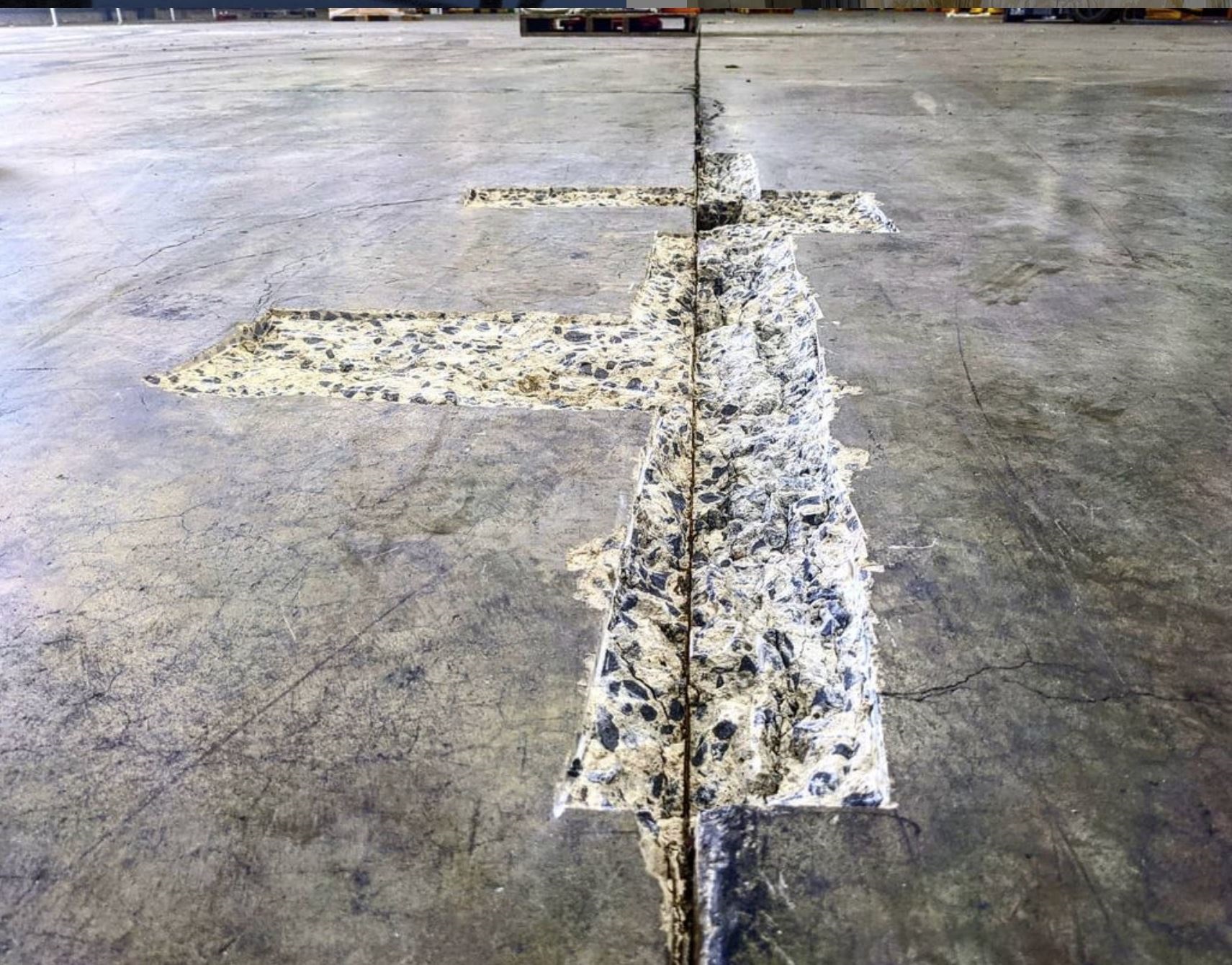
Cracked and chipped concrete before repair and coating

The upper slab, the steps and the run below

The patio at the door is the flat part and the most forgiving. It carries the furniture, it gets crossed barefoot in summer and in boots the rest of the year, and what it wants is a closed surface with enough texture to be safe after rain and a color that still matches itself after a few full summers of sun.

The steps are the part that actually decides the specification. Treads take the most concentrated traffic of anything outdoors, a nosing wears faster than a flat surface because everything lands on the same inch of it, and a step is where a wet or icy surface causes an injury rather than an inconvenience. They are small in area, so a higher texture on them costs very little, and they are worth specifying on their own rather than being included in whatever the patio gets.

The sloped run is the third piece, and it is different again. A path on a grade sheds water along its length rather than off its edge, so water travels down it and keeps going across it, and everyone using it walks the same narrow line. Both of those concentrate wear where a coating has to be at its best.

Then the flat area at the bottom, the pad at a garage or a shed, and any landing between flights. Taking the whole run in one visit is what makes it one surface rather than a set of separately finished pieces that never quite match.

Outside space on a slope, used more often

A terraced yard tends to be used less than a flat one, because getting between the levels is a small deterrent and a slippery step in the rain is a large one. A finish with grip built into it where the grade is takes that away, and the practical result is that the lower part of the yard stops being somewhere you only go in summer.

The upkeep drops to sweeping and a wash. Marks that would have soaked into open concrete come off a closed surface instead, and there is no annual routine of resealing or scrubbing at something that went in months ago. On a run with steps in it that matters more than usual, because steps are the part of any outdoor surface that is hardest to clean and quickest to look neglected.

It also reads as one thing from the house. Where the yard drops away, the whole run of concrete is visible from the back of the property at once, and mismatched slabs poured years apart are obvious from that angle in a way they never are standing on them. One color across all of it changes how the whole yard looks from inside.

Blend and texture graded by where you walk

Texture is the first decision here, and unlike a flat patio it gets specified level by level. A slip-resistant additive can be broadcast into the topcoat on the treads, the nosings and the sloped section, where it earns its place, and left lighter across the flat patio where people stand around in bare feet. Getting that split right is most of what makes a stepped run work, and it is decided by walking it rather than by looking at a plan.

The blend is the second. A denser broadcast gives a busier surface that hides leaf marks, pollen and the general traffic of a yard, which suits a run under trees or a path that collects everything washing down the slope. A lighter blend reads calmer and closer to a single color, which suits a patio meant to be an extension of the house. On a run that crosses both conditions, one blend across all of it is usually still the right answer, because the point is that it reads as one surface.

The topcoat is the third and it is the specification decision that genuinely separates an outdoor floor from an indoor one taken outside. Outdoors it has to hold its color under direct sunlight for years rather than months. Metallic epoxy is an indoor finish and does not go on a patio.

Water arriving from above the slab

On a slope the drainage question is different from the one a flat patio asks. A flat slab is built with a slight fall so water runs off it, and the failure is water sitting still. On a grade, water arrives from uphill, crosses the concrete and keeps going, so what matters is where it enters the run, what it carries with it, and whether anything downhill is holding it against the slab.

We look for that on the visit and tell you what we find, because coating over water that is being trapped is treating a symptom. A step, a raised bed, a retaining edge or a section added later can all quietly dam a run that used to drain, and where that is the real problem no finish laid over the top will fix it.

The concrete itself is opened up before anything is applied. Diamond grinding cuts off laitance and whatever was previously put on the slab and leaves a mechanical key for the system to bond into; cracks and control joints are cut out and filled first. Terminations are what decide how long the finish lasts, and a stepped run has far more of them than a flat patio: every exposed edge, every nosing, every landing and every line where one pour meets another is a place water can get in behind the coating, so each of them is cut in and detailed by hand.

Bare concrete with varied shades where pours meet

Walking the whole run before we price it

We come out and walk the concrete before quoting, from the door down to wherever it ends, because on a stepped site the shape of the job is not obvious from an area measurement. We check for spalling and cracking, look at how the surface takes water, and see where the water actually goes when it rains rather than where it was meant to go.

Then color and texture get chosen outdoors, on your own concrete, in daylight. Both look different outside than they do on a sample card indoors, and the texture split between the flat areas and the steps gets agreed standing on them.

You get a written specification covering the preparation, the crack and joint work, the coats, the topcoat and the texture by area, detailed enough to hold against any other quote. If part of the run is too far gone to take a coating and would be better broken out, we will say so rather than take the work and hand back a finish sitting on concrete that is failing underneath it.

Diamond grinding a slab open before the coats go down

Lemont yards on the side of the valley

We cover Lemont and the neighboring communities from our shop in Roselle, using our own crew rather than subcontracted labor. The village sits on the side of the river valley and a great deal of the housing sits on ground that moves with it, which is why so much of the outdoor concrete here comes in levels: a patio at the door, steps down, and a path running out to the yard or the garage below.

Outdoor slabs here also have a harder life than most people credit, and it is not the cold that does the damage so much as water getting into open concrete and freezing inside it, over and over, through a winter that offers plenty of chances. On a slope there is simply more water crossing the concrete to get in, and the steps take the worst of it. Keeping the water out is the most useful thing a coating does for the concrete underneath it.

Get the whole run of Lemont concrete quoted

We work throughout Lemont and the surrounding communities from our shop in Roselle. The visit is free and commits you to nothing, and on outdoor work it is worth booking early, because a slab that is already losing its surface will only lose more of it over another winter. You will get a straight answer on whether your concrete is a candidate for a coating at all, the texture agreed level by level while standing on it, color chosen outdoors in daylight, and a written quote you can hold against any other. Call (630) 206-5602 or email info@evolveconcretecoating.com to book the slab check. We answer Monday to Sunday, 9 AM to 6 PM.

Areas We Serve

Proudly delivering professional concrete coatings across these Illinois suburbs and surrounding communities.

Every Floor Starts With a FREE Estimate

Contact Us

Thank you! Your submission has been received!
Oops! Something went wrong while submitting the form.