Metallic Epoxy Flooring in Hinsdale, IL

A poured resin floor mixed for one room rather than selected from a range, with samples laid against the stone, cabinetry and paint already chosen so the floor answers the scheme instead of arriving beside it.
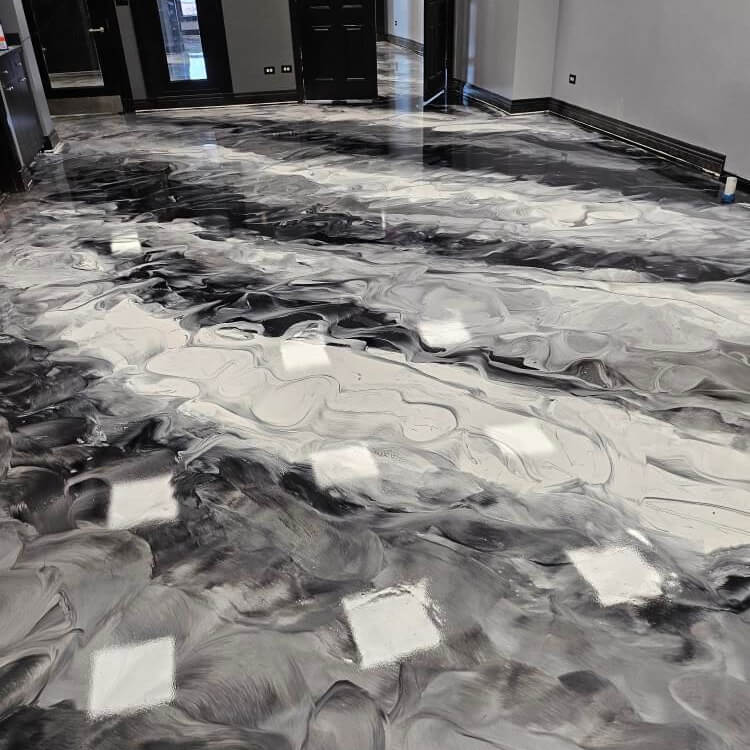
Metallic marble epoxy floor coating

Metallic mixed to suit a room, not picked from a range

There is no chart for this finish, and that is the useful part of it. The pigment is mixed for the job and worked by hand into the wet coat, so the floor is designed for one room rather than chosen from a set of options that exist before anyone has seen the space. Where the rest of a room has already been decided, that is the difference between a floor that fits and a floor that is close.

Underneath the effect it is a full working floor. Seamless from wall to wall with no joints or grout lines, bonded into a ground slab, cracks and control joints opened out and filled first so nothing tracks through, and a clear topcoat over everything that carries the sheen and takes the wear. What wears over the years is that clear layer rather than the depth beneath it, and the topcoat can be renewed without disturbing the floor under it. It is an indoor finish, and that is a rule about the product rather than a preference.

Every quote sets out the preparation, the base coat, the metallic coat, the topcoat and the sheen in writing, which also makes it comparable against anything else on the table. Metallic floors we have installed, including black and white, are on the gallery.

Room with a glossy black and white marbled epoxy floor and gray walls
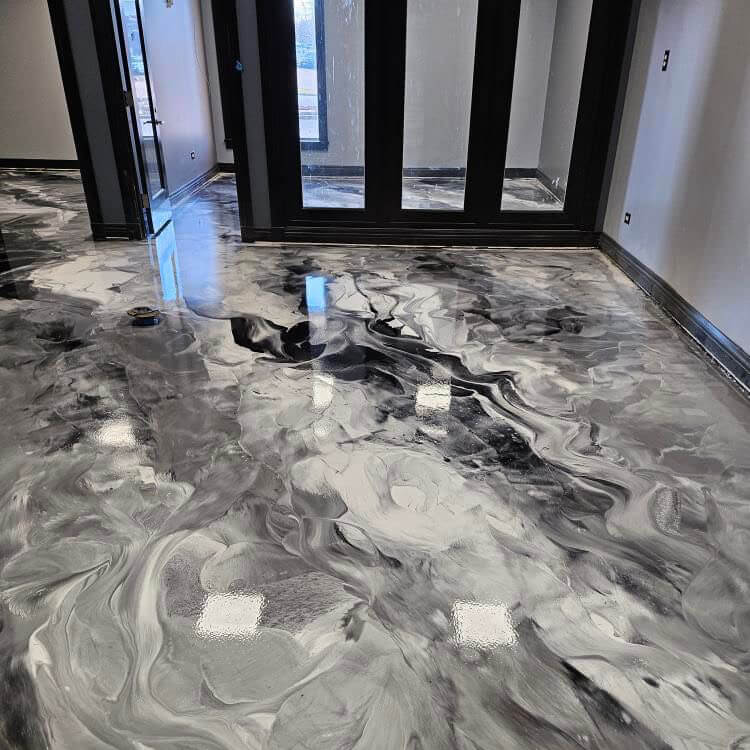
Metallic epoxy flooring in an interior room

Rooms where every other finish is already chosen

The common case locally is a room in the middle of a renovation, where the cabinetry, the stone, the tile and the paint have all been specified and the floor is the last open decision. That order is an advantage rather than a constraint. A poured floor can be mixed to sit against fixed materials, which is not something a manufactured floor covering can do once its range has been narrowed to what is in stock.

Feature rooms and entertaining space are where it usually lands in a house: a bar area, a media room, a finished lower level or a room that opens onto the rest of the ground floor and is seen from it. Those spaces are lit deliberately and often artificially, which is the condition that shows depth in a floor most clearly.

It reaches commercial interiors on the same argument. A showroom or a reception area has a scheme, a set of materials and a look it is trying to hold, and the floor is the largest single surface working for or against that. Being able to mix to the scheme rather than select near it is worth more in those rooms than anywhere else.

What a poured floor is like to live with

It is one continuous surface, so the ordinary maintenance of a floor mostly disappears. Nothing lifts at an edge, nothing needs regrouting, and there is no product line to match years later if part of the room is ever altered. Cleaning is a mop rather than a routine.

It also ages as a material rather than as a style. There is no motif, no repeat and no printed pattern to date it, and the depth is closer in kind to stone or figured timber, which is why the finish tends to keep working in a room long after the decisions made around it have been revisited.

And it stays a working floor while it does that. The topcoat takes foot traffic, furniture and cleaning, spills sit on the surface rather than going into it, and there are no seams for grit to collect in. A room can be genuinely used without the floor becoming something that has to be protected.

Deciding the floor against what is already in the room

The base coat is the first decision and the one most people do not know they are making. The metallic layer is poured over it and reads against it, so the base is what sets whether the finished floor comes out light or dark overall. Where there is stone or cabinetry already chosen, that is usually what settles it, because the base is the part of the system that can be moved to meet them.

How strongly the movement is worked is the second. The pigment separates and travels inside the coat as it cures, and how far that is encouraged runs from a quiet drift that reads almost as a textured color through to a strong, high-contrast surface that is plainly the feature of the room. Which end suits depends entirely on how much is already going on around it. A room with figured stone and strong cabinetry usually wants the quiet end, and saying so is part of the job.

Sheen is the third and it changes a room as much as color does. A high gloss returns light and deepens the effect, a lower sheen keeps the depth while calming the reflection and showing less day to day, and the right answer depends on the glazing and the fittings that are already in place. All three are settled from samples rather than described, because the mix is made for the job and no chart would tell you anything reliable.

The slab under a floor built to be looked at

Preparation is more visible on this finish than on any other we install. The slab is diamond-ground open so the system keys into it mechanically, laitance and any earlier coating or sealer come off, and cracks and control joints are opened out and filled before anything is poured, because every one of those would otherwise read straight through a surface designed to be looked at.

Flatness gets the same attention for the same reason. A reflective floor shows a dip in a slab that a matte finish would hide, so the grind is used to correct what it can before the base coat goes down, and where the slab cannot be brought far enough we say so rather than pouring over it.

The perimeter and the thresholds are the last part and they matter in a finished room. Where the floor meets tile, timber or a fitted unit, the termination is cut in and detailed rather than run up to and stopped, because in a room where everything else has been specified carefully that is exactly where the eye goes.

White and black metallic epoxy flooring

Samples laid next to the materials they answer to

We bring samples to you and lay them on your own floor, in the room, under the light it will actually live in. Metallic is the least suited of anything we install to being chosen from a photograph, because the whole character of it is how it answers one particular room.

Bring the other materials to that visit if they are not already in place. A door front, a stone offcut, a paint sample or a tile is enough, and seeing the floor against them is what turns the decision from a description into something you can look at. It is also far cheaper to change your mind at that point than at any later one.

Where a builder or a designer is running the project we work to their program and their sequence, and we give a written specification covering the preparation, the base coat, the metallic coat, the topcoat and the sheen so it can be checked against the rest of the schedule rather than taken on trust.

Diamond grinding a slab flat before a metallic pour

Hinsdale rooms and renovations this suits

We cover Hinsdale and the neighboring DuPage suburbs from our shop in Roselle, and the people who bring the samples are the people who pour and work the floor.

Locally most of this work sits inside a wider renovation rather than standing on its own, which shapes how the decision gets made. The floor is usually specified late, against materials that are already fixed, and to a schedule that other trades are working to as well. That suits a poured finish, since it can be mixed to meet what has been chosen. It also means the most common correction we make at the sample visit is downward: in a room that already has a lot in it, a quieter floor is very often the better one, and that is easier to establish with samples down than to argue in the abstract.

See metallic samples in your own Hinsdale room

We work throughout Hinsdale and the surrounding DuPage suburbs from our shop in Roselle, with our own crew rather than subcontracted labor. The visit is free and commits you to nothing. Tell us which room it is for, roughly how bold you want it, and what else is going into the space, and we will bring base colors worth looking at rather than a folder of everything. If the room turns out to want something quieter than you first had in mind, we will say so on the day. Call (630) 206-5602 or email info@evolveconcretecoating.com to book a sample visit. We answer Monday to Sunday, 9 AM to 6 PM.

Areas We Serve

Proudly delivering professional concrete coatings across these Illinois suburbs and surrounding communities.

Every Floor Starts With a FREE Estimate

Contact Us

Thank you! Your submission has been received!
Oops! Something went wrong while submitting the form.