Metallic Epoxy Floors in Burr Ridge, IL

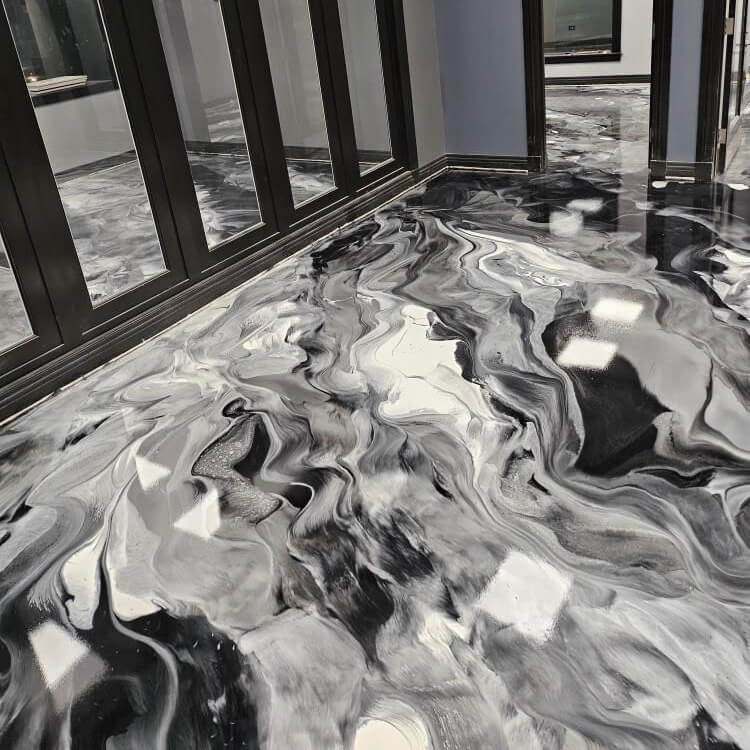
A poured resin floor laid as one continuous surface across a large open room, with the movement worked in by hand and no seam, joint or repeating module anywhere in it.
Metallic epoxy floor coating across an open room

Metallic poured as one surface across a big room

The larger the room, the more a floor gives itself away. Anything laid in pieces has a module, and across a wide open area that module repeats often enough to be read as a pattern, along with every seam, joint and transition holding it together. A poured floor has none of that. It goes down wet, it is worked while it is wet, and it finishes as a single surface from one wall to the other however far apart those walls are.

The effect itself is formed inside the coat rather than applied on top of it. Pigment separates and travels through the resin as it cures, so the depth sits within the thickness of the floor, shifts as you cross the room and changes as the light moves through the day. A clear topcoat over the whole thing carries the sheen and takes the wear, which means what wears is the clear layer rather than the depth underneath it, and it can be renewed without touching the floor below.

It remains a working floor under all of that: bonded into a ground slab, with cracks and control joints opened out and filled first so nothing tracks through, and cleaned with a mop. It is an indoor finish, which is a product rule rather than a preference. Metallic floors we have installed, including black and white, are on the gallery.

Metallic marble floor
Glossy black floor with swirling orange metallic epoxy in an empty room

Open floors, lower levels and reception space

Open plan ground floors are the clearest residential case. Where a kitchen, a dining area and a living space share one continuous floor, every alternative involves either running the same covering through all of it or introducing transitions at the points where the use changes. A poured floor removes the question, because there is nothing to transition between.

A large finished lower level is the second, and it is often the better room for this finish. Basement lighting is artificial and directional, which is the condition that shows movement in a metallic floor most clearly, and a lower level in a house of this size is usually one of the biggest uninterrupted floor areas on the property.

Commercial rooms make the same argument with different reasoning. A reception area, a showroom or an open office floor plate is judged partly on whether it reads as one considered space, and the floor is the largest single surface deciding that. Where the area is big and the sight lines are long, a continuous surface does something no modular floor can.

A large floor with nothing repeating across it

Across a big area the practical benefits compound rather than staying the same. There is no grout to keep clean over hundreds of square feet, no joints collecting grit along the routes people walk, and no edges quietly lifting somewhere you do not look often. Cleaning a large open floor is a mop rather than a schedule.

There is also nothing to match later. A modular floor covering laid across a wide area carries a permanent liability: if part of it is damaged or altered, the replacement has to match a product that may not exist by then, and over a big floor the odds of needing to do that at some point are simply higher. A poured floor has no product line to match, and the topcoat can be renewed across the whole area at once.

And it takes real use while it does that. The surface is seamless and non-porous, so spills sit on top of it, furniture moves across it without catching an edge, and traffic concentrates on the topcoat rather than on the finish you paid for. In a room that is genuinely used rather than looked at from the doorway, that distinction is what makes the floor worth having.

How much movement a big floor can carry

Area changes this decision, and it is the thing most people get wrong from a sample. A pattern that reads as pleasant on a small board is being multiplied by the size of the room, and a strong, high-contrast floor across a large open area is a very different proposition from the same finish in a study. The bigger the floor, the more often the quiet end of the range turns out to be the right answer.

The base coat is what sets the overall weight of it. The metallic layer is poured over the base and reads against it, so the base decides whether the finished floor comes out light or dark before any question of contrast arises. Over a large area that matters more, because the base color is what the room's general tone will be even where the movement is subtle.

Sheen is the third decision and on a big floor it interacts with the room. A high gloss returns light and deepens the effect, which is right in a reception area and can be too much across an open plan floor with a lot of glazing and overhead fittings. A lower sheen keeps the depth, calms the reflection and shows less day to day. All three are settled from samples laid on your own floor, at a size that means something, under the light the room actually has.

Flatness over a long sight line

Preparation is more exposed on a large poured floor than on a small one, because you can see further across it. A reflective surface shows undulation that a matte finish or a modular covering would break up, and a dip that would go unnoticed in a small room is visible down the length of a big one. So the slab is diamond-ground open both to key the system in mechanically and to correct what the grind can correct before anything is poured.

Everything that would read through gets dealt with first. Laitance and any earlier coating or sealer come off, cracks and control joints are opened out and filled, and old patches and repairs are ground back rather than coated over, because on a floor built to be looked at every one of them would otherwise show.

Where the slab cannot be brought flat enough, we say so before pouring rather than after. On a large area that is an honest conversation worth having early, because the cost of the finish rises with the area and so does the cost of being wrong about the concrete underneath it.

Black and white metallic epoxy floor

Planning a pour that cannot stop halfway

A large floor is poured as one operation, which makes the planning part of the specification rather than an afterthought. The area is set out before anything is mixed, the route through the room is decided, and the crew works to a wet edge so there is no stop line anywhere across the middle of the floor. That is the whole reason it finishes as one surface.

So the survey covers more than measurements. We look at how the room is reached, where the material can be mixed, what has to come out of the space, and where columns, islands or fitted units break the area up, because all of it changes how the pour is staged. In a commercial room we agree the staging around your operating hours at the same time.

You are left with a written specification covering the preparation, the base coat, the metallic coat, the topcoat and the sheen, and on an area this size it is worth having in that form. It says what is being poured rather than naming a product, and it can be compared properly against anything else you are holding.

Diamond grinding a large slab flat before pouring

Burr Ridge rooms with distance in them

We cover Burr Ridge and the surrounding DuPage and Cook suburbs from our shop in Roselle, and the people who bring the samples are the people who pour and work the floor.

The building stock here pushes this decision in a particular direction. Houses sit on large lots and tend towards open plans and generous lower levels, and the commercial space along the corridor runs to low-rise offices with wide floor plates. Both produce rooms with long sight lines, and long sight lines are what make a continuous floor worth the money and a strong pattern worth thinking twice about. That is the most common correction we make with samples down, and it is far cheaper to make it then.

Talk to us about a Burr Ridge metallic floor

We work throughout Burr Ridge and the neighboring suburbs from our shop in Roselle, with our own crew rather than subcontracted labor. The visit is free and commits you to nothing. Tell us the room, roughly how bold you want it and what it is used for, and we will bring base colors worth looking at and lay samples at a size that tells you something about a floor this big. If the area wants something quieter than you first had in mind, we will say so on the day. Call (630) 206-5602 or email info@evolveconcretecoating.com to book a sample visit. We answer Monday to Sunday, 9 AM to 6 PM.

Areas We Serve

Proudly delivering professional concrete coatings across these Illinois suburbs and surrounding communities.

Every Floor Starts With a FREE Estimate

Contact Us

Thank you! Your submission has been received!
Oops! Something went wrong while submitting the form.