Garage Floor Coating in Addison, IL

Flake and solid color floors for Addison garages, ground into the slab and sealed edge to edge, so the room the family actually walks through stops shedding dust and salt into the house.
Epoxy garage floor coating in an Addison home

Coating the garage you walk through every day

A hard, sealed, seamless surface across the whole slab, taken right out to the walls and up the base of them where you want it. Colored flake is broadcast into the base coat while it is still wet and locked under a clear topcoat, so the floor has depth and texture rather than reading as a flat painted slab. In a garage that doubles as the family entrance that texture earns its keep: it grips underfoot when boots come in wet, and it breaks up the surface so ordinary marking never looks like damage.

The coating is bonded into the concrete rather than laid on top of it. That is the difference between this and garage floor paint, and it is why the slab is diamond-ground rather than etched and why more of the day goes on the concrete than on the color. Once it is finished there is no bare concrete left to take up oil or road salt, nothing for tires to lift at the parking bay, and nothing to peel back along the line where the door comes down.

You choose the flake blend and the topcoat from samples we bring to the garage, so the decision is made against your own walls under your own light rather than from a screen. The quote is a fixed written price covering the grinding, the repairs, the coats and the edge detail, with nothing added later for what turns up in the slab. Garage floors we have finished are on the gallery.

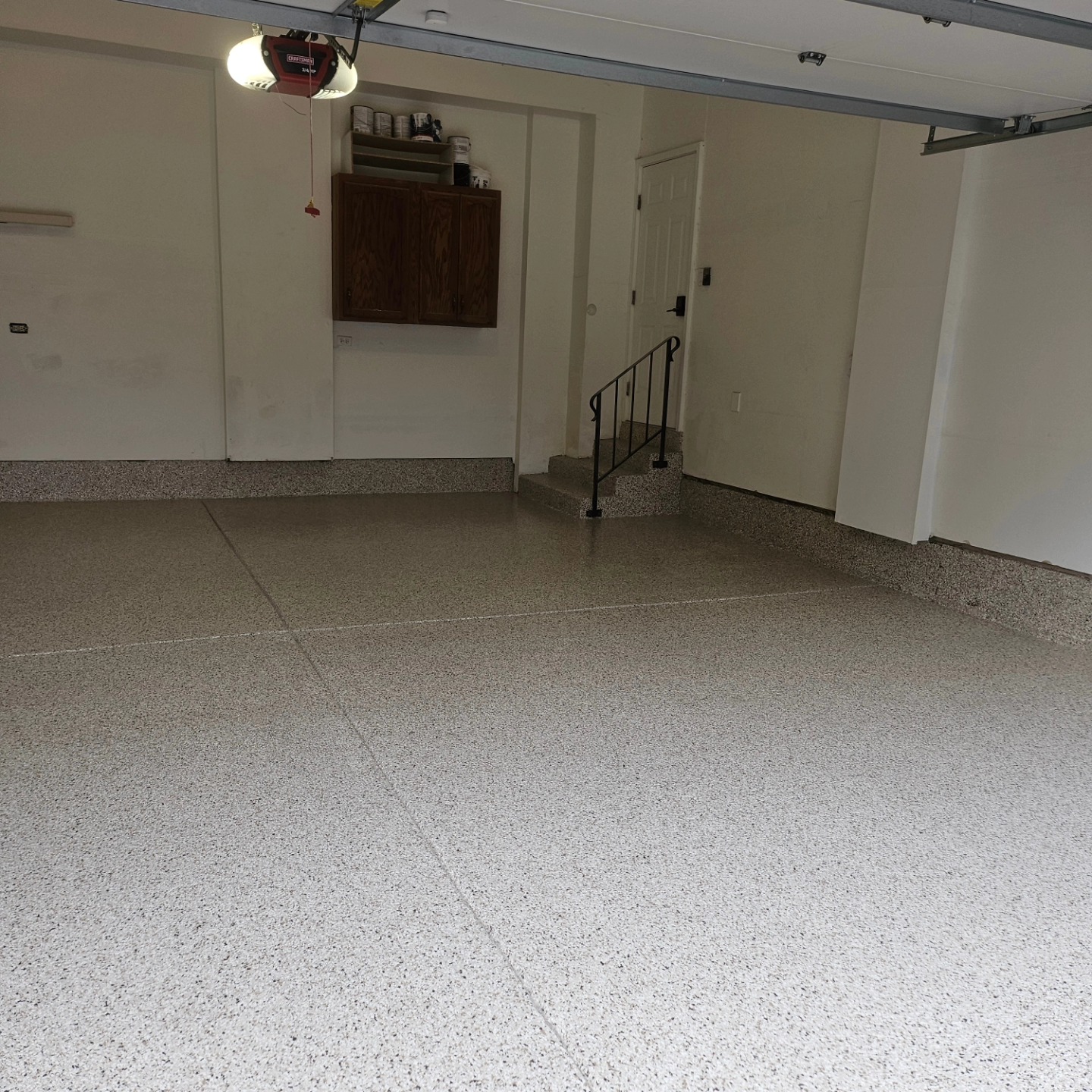
Coated garage floor with steps leading up to the door into the house
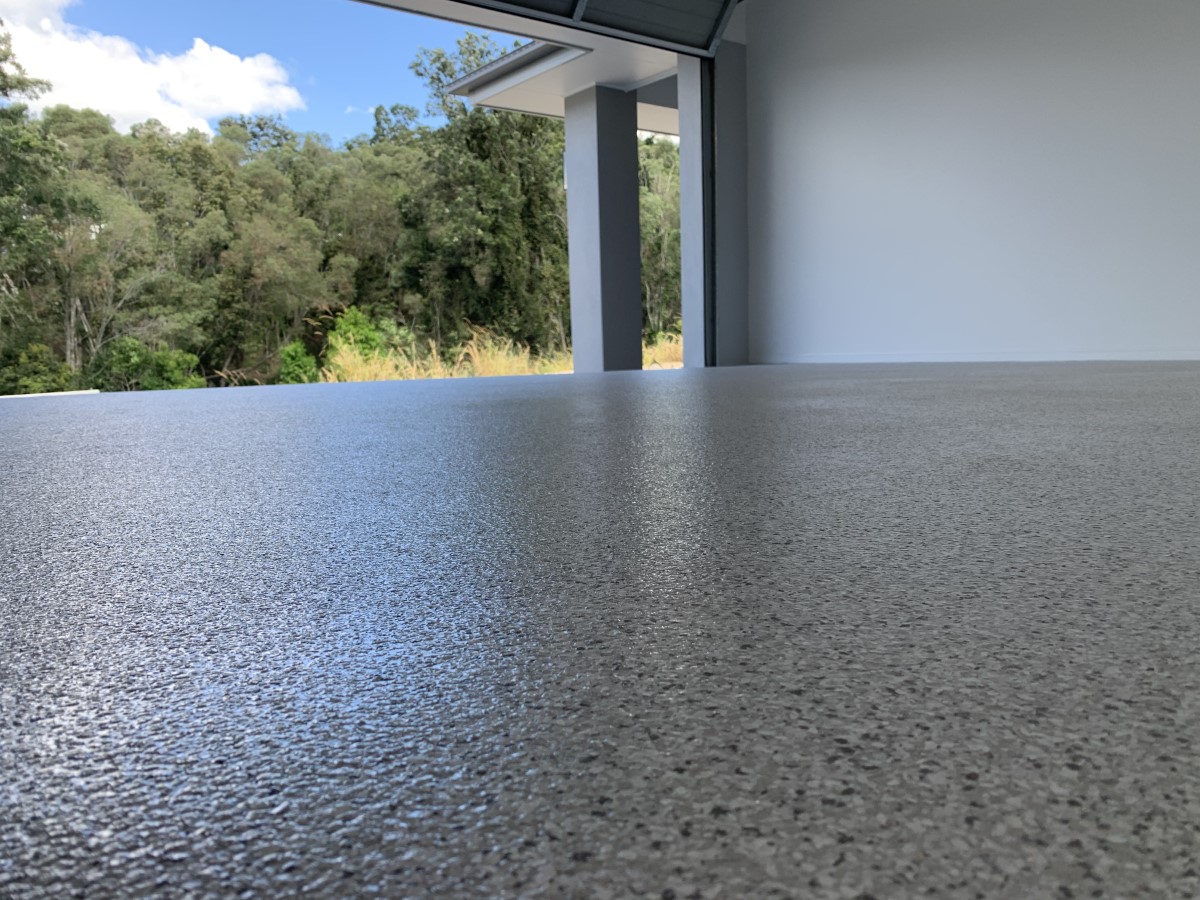
Close-up of a textured epoxy flake garage floor with the door open

What stops coming into the house

The dust goes first, and in an attached garage that matters more than people expect. Bare concrete sheds fine grit continuously, and in a garage with a door into the house that grit does not stay in the garage. It comes through on shoes, onto the mat, into the hall and onto whatever the vacuum reaches next. A sealed floor simply stops producing it, which is the change most households notice within a week.

Salt is the second. Through winter a car brings in slush that melts and sits under it for hours, and on open concrete that solution soaks in and leaves the pale crust no amount of sweeping shifts. On a closed surface it stays on top, so it mops off and the floor looks the same in March as it did in November.

The third change is what the space becomes. A bright sealed floor throws back the light already in there, which makes a two-car garage feel like a room rather than a store. Shelving, a bench, bikes and the recycling all start to look like they belong, and the walk from the car to the kitchen door stops being the worst-looking part of the house.

The parking bay, the route indoors, the storage run

The parking bay sets the specification. It carries the weight and the turning tires, and it takes everything that comes off a vehicle in winter, which is grit, salt and meltwater standing under the car long after it has been parked. That is where the topcoat and the edge detail have to be right, and it is the area worth spending the specification on.

The route from the car to the house door is the part most garages are never designed around. It takes daily foot traffic in both directions, arms full of shopping, a stroller or a bike wheeled across it, and whatever the weather put on everyone's shoes. It needs to be a surface that grips when it is wet and cleans without effort, because it is walked on far more than the rest of the floor.

Then there is the storage down the side and across the end wall. Shelving, seasonal boxes, a spare set of tires and the yard equipment all sit directly on the concrete, and on a sealed slab nothing draws damp up out of the floor or leaves a ring behind when it gets moved. Where there is a bench or a mower in the mix, the floor also has to take dropped tools and the occasional spill of oil or fuel without staining.

Flake, plain color or metallic, and what goes over them

Epoxy flake is what most Addison garages get, and it is what people picture when they picture a coated garage floor. The chips give the surface depth, hide the small marks a working garage collects between cleans, and keep it from going slick when meltwater comes off the car.

Solid color is the plain alternative. One even color across the whole slab with nothing in it to catch the eye, which suits a garage used mostly as a workshop, where a uniform floor makes a dropped fixing or a fresh drip easy to spot.

Metallic epoxy is the decorative option, and it belongs indoors. Pigment is moved through a clear resin as it cures so the color travels in swirls and no two floors finish the same. In a garage it makes sense where the space is a showpiece as much as it is parking.

Over a flake build, polyaspartic is available as the fast-cure topcoat option. It is a topcoat rather than a floor in its own right, so it goes over the flake rather than replacing it. Slip resistance can also be broadcast into the topcoat, and on a garage used as a walkway it is worth putting more of it along the route to the house door than across the parking bay.

An attached slab has its own quirks

An attached garage floor is not a free-standing slab and it should not be quoted like one. It usually shares a wall and a footing with the house, it steps up at the door into the building, and it has an apron at the overhead door that takes the weather while the rest of the floor never does. All of that changes where the work is, so we look at it rather than assume it.

The whole floor gets diamond-ground. Grinding takes off old paint, previous sealer and the weak laitance layer left by the original pour, and it opens the concrete so the coating keys into it mechanically. Acid etching does not do that reliably, and a floor that lifts in its first year was almost always etched instead of ground.

Then the repairs. Cracks are opened out and filled, pitted and spalled areas are made good, and control joints are treated so they do not telegraph straight back through the finished floor. At the door line the edge is cut in and terminated properly, because that is the one part of an attached garage floor exposed to the weather, and it is where a badly finished job gives up first.

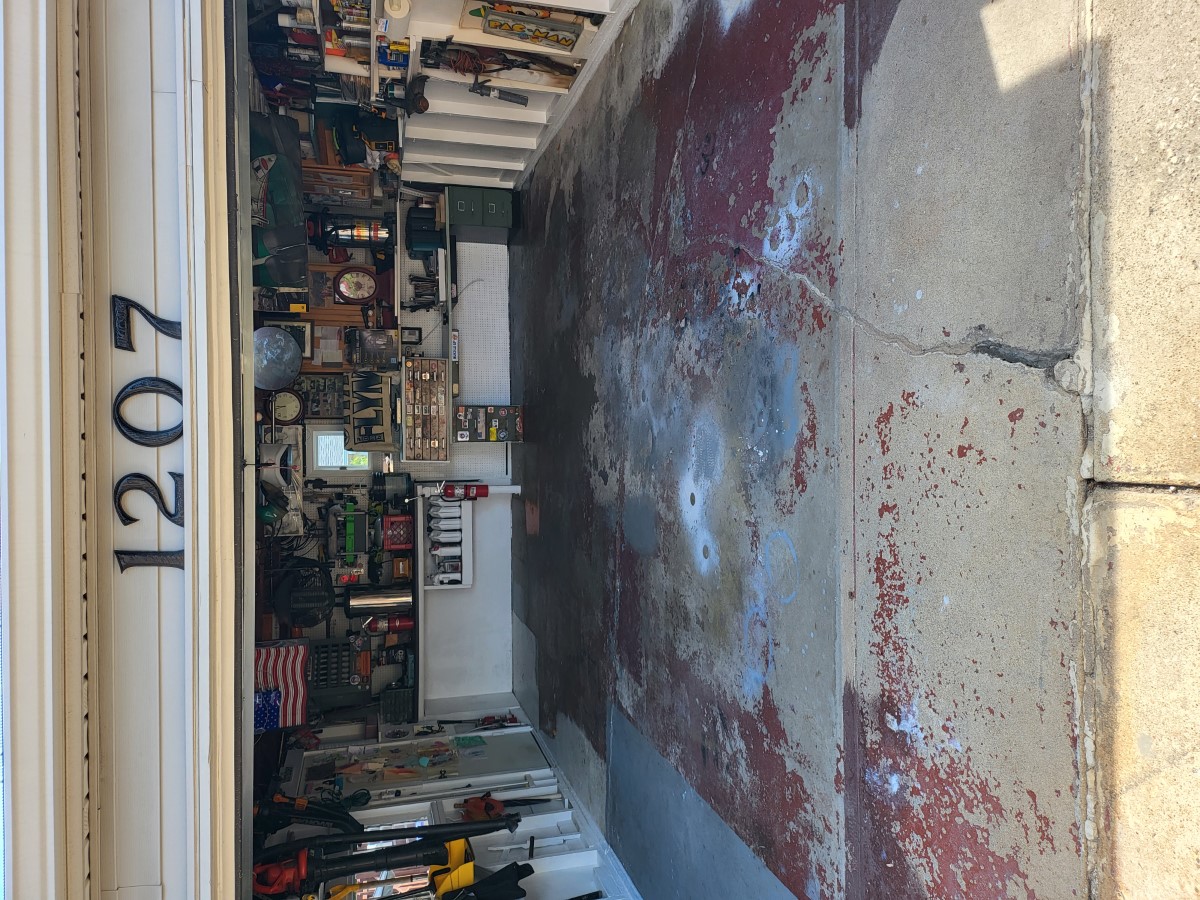
Worn garage slab with peeling paint and oil marks before preparation

The measure, the samples and the fixed price

It starts with a visit. We measure the garage, look properly at the concrete, and talk through what the space is really for, because a floor that parks two cars and a floor that also serves as the family's front door are not specified the same way.

From that visit you get a written fixed price covering the grinding, the crack and joint repair, the coats, the topcoat and the edges. If the slab has something in it we would not recommend coating over, we say so at the visit rather than after you have committed to a date.

On the day the garage needs to be cleared and it stays ours until the work is done. We grind, repair, prime, lay the base coat and broadcast the flake, then come back to scrape it back, vacuum and put the topcoat on. We tell you at the survey when the space comes back to you and we plan the job around that, including how you get in and out of the house while it is down.

Diamond grinding a garage slab before the coating goes down

Addison garages and the door into the house

We cover Addison and the surrounding DuPage suburbs from our shop in Roselle, close enough that looking at a garage is a short trip rather than an expedition. A lot of the housing here is post-war and later, and the pattern it produced is a two-car attached garage opening onto a short drive, with a door straight through into a mud room, a hall or the kitchen.

That layout is the thing worth knowing about an Addison garage. It is not really an outbuilding, it is the entrance the family uses, and it is joined to the heated part of the house by a door that gets opened dozens of times a day. Anything the floor sheds ends up on the other side of that door, which is why sealing the slab does more here than it would on a detached garage at the end of a yard. The slabs themselves are usually sound and usually have had something on them at some point, so the grinding and the repair work are the part of the job to pay attention to.

Book a measured quote on your Addison garage

We work throughout Addison and the neighboring suburbs from our shop in Roselle, with our own crew rather than subcontracted labor. The visit is free, it takes a few minutes and it commits you to nothing. You will get flake samples down on your own garage floor, a straight assessment of what the slab needs before anything is coated, and a fixed written price that covers the preparation rather than treating it as an extra to add on later. Call (630) 206-5602 or email info@evolveconcretecoating.com and we will arrange a time to come and measure up. We answer Monday to Sunday, 9 AM to 6 PM.

Areas We Serve

Proudly delivering professional concrete coatings across these Illinois suburbs and surrounding communities.

Every Floor Starts With a FREE Estimate

Contact Us

Thank you! Your submission has been received!
Oops! Something went wrong while submitting the form.