Basement Floor Coating in River Forest, IL

Seamless resin floors bonded onto the basement slab of an older River Forest house, adding almost no height under a low ceiling, working around the posts, the stairs and the utilities, and giving a hundred-year-old lower level a finished floor that is warm to look at and easy to keep clean.
Epoxy floor in a finished basement room

A finished floor on the slab an old house already has

A basement floor coating is a resin system bonded directly into the concrete slab that is already down there. It is ground, primed, coated and sealed under a clear topcoat, and it cures into one continuous floor with no seams, no joints and no edges to lift. We install it as epoxy flake, solid color or metallic, and in every form it is a real finished floor rather than a treatment: something a room can be furnished on, walked on barefoot and cleaned with a mop.

In an older house that matters more than anywhere else. The basement under a home built in the early decades of the last century usually has a low ceiling, a slab that was poured by hand and has settled and worn unevenly since, and a floor plan broken up by the stairs, the support posts, the boiler and the drains. Almost nothing else you could put on that floor works well there. A coating adds a fraction of an inch, follows the slab into every corner, terminates cleanly around each post and drain, and turns the concrete you already own into the floor.

Every quote sets out the preparation, the system, the finish and the detailing around the fixed features in writing, so there is nothing to take on trust. Basement floors we have finished are on the gallery.

Sealed concrete floor in an older basement
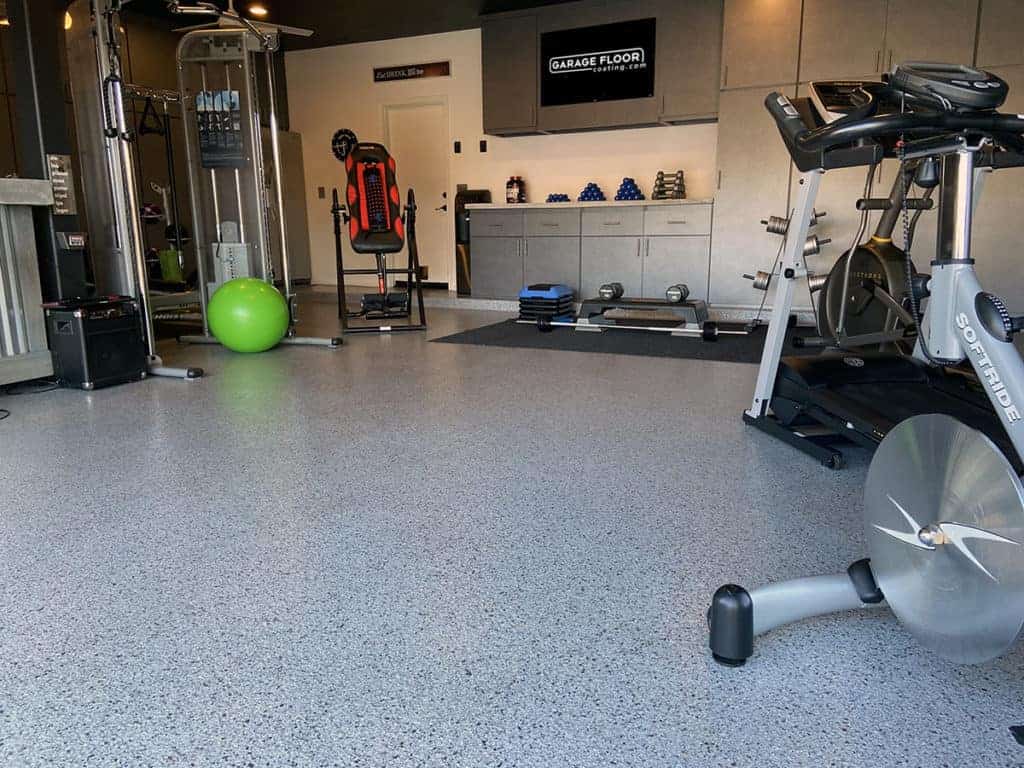
Home gym with a gray epoxy flake floor and exercise equipment

Living on a coated floor in a period basement

The floor becomes a surface you can use rather than a surface you keep things off. A sealed, non-porous coating takes furniture, exercise equipment, a laundry basket set down wet and a child's toy box without marking, and it does not hold the damp, cellar smell that a bare slab or a carpet over one always ends up with. The room starts to feel like part of the house rather than the space underneath it.

Cleaning is a sweep and a mop. There is no carpet to pull up after a wet spring, no laminate to swell at the seams, no grout to darken and nothing for dust and spider webs to work into. A spill from the washer, a dropped can of paint or tracked-in slush from the back stairs sits on the surface and wipes up, and the slab underneath is never touched.

It also stays the floor for as long as you want it to. The clear topcoat takes the wear and can be renewed years later over the same floor, and if the room changes use, from storage to a gym to a den, the floor does not need to change with it. In a house that has already been standing for a century, a floor that will not need replacing is a sensible thing to install.

Laundry, workshop, playroom and the room under the stairs

Older basements are usually several small spaces rather than one open room, and the floor has to work across all of them. The laundry and utility end wants a plain, sealed floor that shrugs off water, detergent and lint and is easy to see is clean, which is where a solid color finish belongs. It runs under the appliances and around the floor drain as one surface with nothing for water to get under.

A workshop or a hobby room wants a hard floor that takes dropped tools, sawdust, glue and the odd spill, and that can be swept without raising dust off the concrete. A flake floor in a mid-tone hides the debris between cleans and gives grip underfoot, and it does not care what is dropped on it.

The finished part of the basement, the playroom, the den or the home gym, is where the floor is chosen for how it looks as well as how it works. Flake in a warm blend suits a family room under an old house; a quiet metallic suits a lower level that has been opened up and lit properly. Where the space is broken up by posts and the stair, one continuous floor across all of it is what makes it read as a single room.

Epoxy flake, solid color and metallic on an older slab

Epoxy flake is the most forgiving floor for a period basement. Colored flake is broadcast into the body coat and sealed under a clear topcoat, so the surface is textured, slip-resistant and busy enough to hide the dust, grit and small marks that a lower level collects. It also hides the slight unevenness of an old hand-poured slab better than any smooth finish would. A polyaspartic topcoat can be specified over the flake where a harder-wearing, fast-cure finish suits the room.

Solid color epoxy is the plain, uniform floor: one color across the whole area under a clear topcoat. It suits the working end of the basement, the laundry, the boiler room and the storage bays, because it shows what is on the floor and confirms at a glance that the room is dry and clean. In a light color it also lifts a low, dark space more than any lighting scheme can.

Metallic epoxy is the finished-room floor, poured and worked by hand so the color moves in depth across the surface. It belongs in a lower level that has been properly finished, with a ceiling that has been lifted or lit well, where the floor is meant to be looked at. It is an indoor finish and it needs a slab that has been brought flat, which on an older basement floor is part of the preparation rather than an assumption.

Preparing a hand-poured slab that has settled for decades

An old basement slab is rarely flat, rarely clean and rarely uniform. It has been painted, sealed, patched and sometimes carpeted over, it has settled unevenly around the footings, and it carries the history of every leak and every workshop that has been down there. The preparation is built around that rather than around a slab that does not exist.

The slab is diamond-ground open across the whole area, taking off paint, old sealer, adhesive and laitance and giving the new system a mechanical key into clean concrete. High spots are ground down and low spots, cracks and the rough patches around old drains and footings are filled level with a repair mortar before the primer goes on, so the coating is laid over one continuous plane rather than following every dip in the original pour.

Moisture in an older slab is looked at, not assumed. A basement floor that has been damp for decades tells you so, and where a slab needs it the system is built on a moisture-tolerant primer so the floor stays down. The perimeter, the posts, the stair stringer and every drain are detailed by hand, because in a cut-up old basement that is most of the floor's edge.

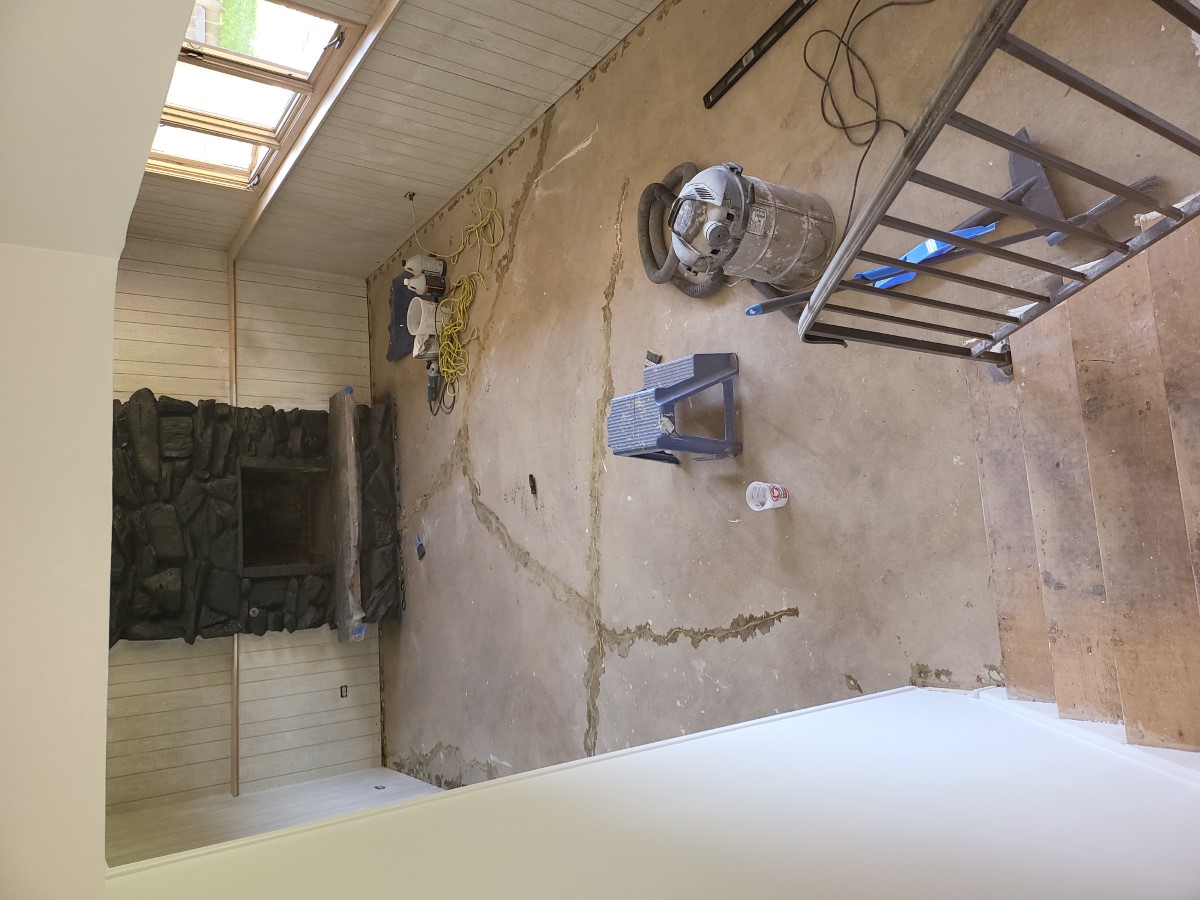
Unfinished basement with a bare, uneven concrete floor before preparation

Walking the basement before anything is priced

We come out and look at the basement with you, walk every part of it, look at how the slab has been treated and how it has behaved, and talk through which floor suits which end of the space. That visit is what the specification is built from, and it is free.

An older house brings its own questions: whether the old paint is coming off cleanly, whether the slab can be brought flat enough for the finish you want, how the floor should meet the bottom step and the doorway to the outside, and what to do about the boiler and the fixed shelving that are not going anywhere. Those are answered on the day, in the room, from experience with basements like it, rather than guessed at from a photograph.

The written quote sets out the preparation, the system in each area, the finish, the moisture approach and the detailing around every fixed feature, with a fixed price. If part of the slab needs more than a coating can fix, we say so at the visit rather than once the grinder is running.

Diamond grinding an old basement slab before the coats go on

Older houses in River Forest and the basements under them

We cover River Forest and the neighboring Cook County suburbs from our shop in Roselle, and the people who come out to look at the basement are the people who lay the floor.

River Forest is a village of older houses, much of it built in the early decades of the last century, and the basements under those houses share the same character: low ceilings, hand-poured slabs that have settled, stone or brick foundations, posts in awkward places and a floor plan cut up by the stairs and the utilities. Very little else works well as a floor down there, which is why a bonded coating that adds no height and follows the slab into every corner is what we recommend for most of them.

Arrange a look at your River Forest basement

We work throughout River Forest and the surrounding suburbs from our shop in Roselle, with our own crew rather than subcontracted labor. The visit is free and commits you to nothing. Tell us how the basement is used now, what you want it to become and what the slab has been through, and we will recommend flake, solid color or metallic for each part of the space, explain how the old slab will be prepared and put the whole job in writing with a fixed price. Call (630) 206-5602 or email info@evolveconcretecoating.com to arrange a visit. We answer Monday to Sunday, 9 AM to 6 PM.

Areas We Serve

Proudly delivering professional concrete coatings across these Illinois suburbs and surrounding communities.

Every Floor Starts With a FREE Estimate

Contact Us

Thank you! Your submission has been received!
Oops! Something went wrong while submitting the form.